Sample Compatibility Report
This is a sample of our Compatibility Report. Maya and Leo are fictional people. Their birth details are made up, but their charts are real output from the same engine that runs our free chart, and you can open both receipts. The excerpts below are the report's own wording for these two charts.
What you're looking at: eight chapters (the sample PDF runs to 9 pages). Each chapter opens with Chart evidence (the exact facts it uses), then a Reading, then one question to reflect on. There's no compatibility score or match verdict. The only percentages in it are each person's Day Master strength share, produced by our published point method.
The two charts
| Maya (Person A) | Leo (Person B) | |
|---|---|---|
| Birth details (fictional) | 15 April 1991, 07:40, Chicago | 28 November 1990, 19:15, Manchester |
| Clock to true solar time | Daylight saving removed (−60 min); true solar time +9.35 min | No daylight saving; true solar time +3.02 min |
| Month opened by | Qingming 清明 (5 April 1991) | Lidong 立冬 (7 November 1990) |
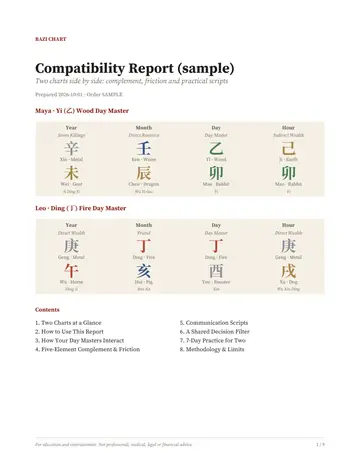
| Year · Month · Day · Hour | 辛未 Xin-Wei · 壬辰 Ren-Chen · 乙卯 Yi-Mao · 己卯 Ji-Mao | 庚午 Geng-Wu · 丁亥 Ding-Hai · 丁酉 Ding-You · 庚戌 Geng-Xu |
| Day Master | Yi (乙), Yin Wood | Ding (丁), Yin Fire |
| Strength (our point method) | balanced, 53% support | weak, 37% support |
| Weighted elements | Wood 3.4 · Fire 0.3 · Earth 2.2 · Metal 1 · Water 1.1 | Wood 0.3 · Fire 2.8 · Earth 0.9 · Metal 3.3 · Water 0.7 |
| Receipt | Maya's chart and receipt | Leo's chart and receipt |
Relations the engine found between the two charts:
- Day Masters: Wood produces Fire. In Maya's chart, Leo's Ding is the Eating God (食神). In Leo's chart, Maya's Yi is the Indirect Resource (偏印). Same polarity (both Yin). No classical stem combination.
- Day branches: Mao 卯 (Maya) and You 酉 (Leo) are one of the six classical clashes (六沖).
- Elements: Maya's chart is rich in Wood and Earth, which Leo's has little of. Leo's is rich in Fire and Metal, which Maya's has little of. No shared prominent element; no element absent from both.
We chose this pair on purpose: it has a supportive Day Master relation and a day-branch clash. Real charts are usually mixed like this, and the report doesn't net one against the other.
Chapter structure
| # | Chapter | What it's built from |
|---|---|---|
| 1 | Two Charts at a Glance | Both sets of pillars, Day Masters, strength |
| 2 | How to Use This Report | Fixed text: how to read evidence, reading and question |
| 3 | How Your Day Masters Interact | Element relation each way, polarity, stem combination, day branches |
| 4 | Five-Element Complement & Friction | Both weighted element balances, compared |
| 5 | Communication Scripts | Each Day Master's element and strength |
| 6 | A Shared Decision Filter | Each chart's most prominent element |
| 7 | 7-Day Practice for Two | Both Day Masters' elements |
| 8 | Methodology & Limits | Fixed text: rules, checks and limits |
What the report doesn't contain, so you know before buying: no score or match verdict, no timing (luck pillars or years) for the couple, no favourable elements, no year-animal (zodiac) reading, no three-harmony, harm or punishment analysis, and nothing about other pillars beyond the two day branches.
Excerpts
Every excerpt below is the report's template text for Maya and Leo, generated by our code. In a delivered report, a writing model may polish the prose of chapters 3–7 from the same facts. Each chapter is then checked against both charts, and any chapter that fails the check is delivered as this template version.
Sample · these charts belong to nobody
Compatibility Report
Two charts side by side: complement, friction and practical scripts
Yi Yin Wood · born 15 April 1991
Ding Yin Fire · born 28 November 1990
Contents
- 1. Two Charts at a Glance
- 2. How to Use This Report
- 3. How Your Day Masters Interact
- 4. Five-Element Complement & Friction
- 5. Communication Scripts
- 6. A Shared Decision Filter
- 7. 7-Day Practice for Two
- 8. Methodology & Limits
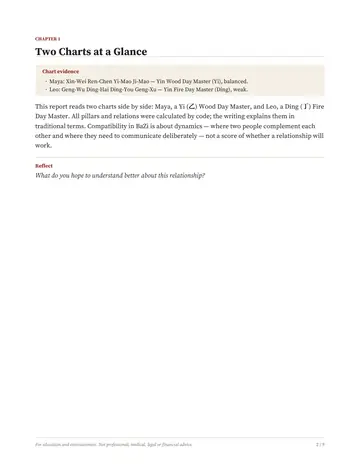
Chapter 1
Two Charts at a Glance
Chart evidence
- Maya: Xin-Wei Ren-Chen Yi-Mao Ji-Mao — Yin Wood Day Master (Yi), balanced.
- Leo: Geng-Wu Ding-Hai Ding-You Geng-Xu — Yin Fire Day Master (Ding), weak.
This report reads two charts side by side: Maya, a Yi (乙) Wood Day Master, and Leo, a Ding (丁) Fire Day Master. All pillars and relations were calculated by code; the writing explains them in traditional terms. Compatibility in BaZi is about dynamics — where two people complement each other and where they need to communicate deliberately — not a score of whether a relationship will work.
Reflect
What do you hope to understand better about this relationship?
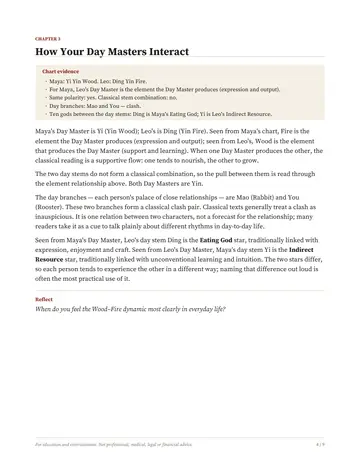
Chapter 3
How Your Day Masters Interact
Chart evidence
- Maya: Yi Yin Wood. Leo: Ding Yin Fire.
- For Maya, Leo's Day Master is the element the Day Master produces (expression and output).
- Same polarity: yes. Classical stem combination: no.
- Day branches: Mao and You — clash.
- Ten gods between the day stems: Ding is Maya's Eating God; Yi is Leo's Indirect Resource.
Maya's Day Master is Yi (Yin Wood); Leo's is Ding (Yin Fire). Seen from Maya's chart, Fire is the element the Day Master produces (expression and output); seen from Leo's, Wood is the element that produces the Day Master (support and learning). When one Day Master produces the other, the classical reading is a supportive flow: one tends to nourish, the other to grow.
The two day stems do not form a classical combination, so the pull between them is read through the element relationship above. Both Day Masters are Yin.
The day branches — each person's palace of close relationships — are Mao (Rabbit) and You (Rooster). These two branches form a classical clash pair. Classical texts generally treat a clash as inauspicious. It is one relation between two characters, not a forecast for the relationship; many readers take it as a cue to talk plainly about different rhythms in day-to-day life.
Seen from Maya's Day Master, Leo's day stem Ding is the Eating God star, traditionally linked with expression, enjoyment and craft. Seen from Leo's Day Master, Maya's day stem Yi is the Indirect Resource star, traditionally linked with unconventional learning and intuition. The two stars differ, so each person tends to experience the other in a different way; naming that difference out loud is often the most practical use of it.
Reflect
When do you feel the Wood–Fire dynamic most clearly in everyday life?
Chapter 4
Five-Element Complement & Friction
Chart evidence
- Maya: Wood 3.4 · Fire 0.3 · Earth 2.2 · Metal 1 · Water 1.1.
- Leo: Wood 0.3 · Fire 2.8 · Earth 0.9 · Metal 3.3 · Water 0.7.
- Maya brings what Leo has little of: Wood and Earth.
- Leo brings what Maya has little of: Fire and Metal.
- Shared prominent: —. Absent in both: —.
- Prominent in one chart and controlling the other's Day Master element: Metal (Leo → Maya).
Placing the two element balances side by side shows where the charts fill each other's gaps and where they double up.
Maya's chart is rich in Wood and Earth, which Leo's chart has little of — traditionally growth, planning and reaching outward and stability, care and holding things together. Leo's chart is rich in Fire and Metal, which Maya's chart has little of — traditionally warmth, visibility and expression and clarity, standards and decisive cuts.
The two charts do not share a prominent element, so each person tends to approach things from a different starting point.
Leo's chart is prominent in Metal, the element that controls Maya's Wood Day Master: traditionally read as structure and pressure. It can feel like helpful structure or like pressure, depending on how it is offered.
Reflect
Which quality does Leo bring that Maya would find hard to supply alone — and vice versa?
Chapter 5
Communication Scripts
Chart evidence
- Maya: balanced Wood. Leo: weak Fire.
Charts suggest communication styles, which makes them useful for practical scripts.
With a balanced Wood Day Master, Maya is often read as needing a mix of space and check-ins. With a weak Fire Day Master, Leo is often read as needing reassurance and time to think before answering.
Three scripts to try:
- When planning: "Here's my idea — what would you add before we decide?"
- When tension rises: "I want to understand what matters to you here. Can you say it another way?"
- When one of you is drained: "What would help most right now: space, help, or just listening?"
Adapt the wording; the point is to name the need the chart describes before the conversation becomes a disagreement.
Reflect
Which of these scripts would have helped in your last misunderstanding?
Chapter 6
A Shared Decision Filter
Chart evidence
- Maya most prominent: Wood.
- Leo most prominent: Metal.
When two people decide together, a shared filter keeps both charts in view.
- Strengths: Maya's chart is most prominent in Wood; Leo's in Metal. Does the choice use what each of you does naturally?
- Pace: does the plan respect the slower and the faster of you?
- Roles: who contributes what, given each chart's strengths?
- Review: agree in advance when to look at the decision again.
Use it for something concrete — a trip, a move, a project — and notice where you agree quickly and where you need more conversation.
Reflect
Which joint decision coming up would you like to run through this filter together?
Chapter 7
7-Day Practice for Two
Chart evidence
- Maya: Wood. Leo: Fire.
A week of small shared practices, built from the two charts.
- Day 1: each of you names one quality you appreciate in the other's Day Master (Wood and Fire).
- Day 2: notice one moment when your styles complement each other.
- Day 3: try one communication script from this report.
- Day 4: do one activity that brings in an element you both have less of.
- Day 5: let the quieter partner choose the plan for the evening.
- Day 6: run one small decision through the shared filter.
- Day 7: talk about what you noticed, and keep one practice.
Reflect
Which practice felt most natural — and which felt like a stretch worth keeping?
Chapter 8
Methodology & Limits
Chart evidence
- Both charts: year boundary at Lichun, months at the twelve jie solar terms.
- Hour and day pillars from true solar time when a birthplace is given.
- Pair relations: Day Master element roles, ten-god names between the two day stems, the five stem combinations, six harmonies and six clashes of the day branches.
Both charts were calculated by code with the same rules: the year changes at Lichun (the start of spring), months change at the twelve jie solar terms, and when a birthplace was given the hour and day pillars use true solar time. Element weights count visible stems and hidden stems with published weights; Day Master strength is a heuristic support ratio with the month branch weighted double. The relations between the two charts are a fixed set of classical comparisons, also computed by code: how each Day Master's element relates to the other's, the ten-god name each day stem carries for the other, whether the day stems form one of the five classical combinations, and whether the day branches form a six-harmony or clash pair. No writing model was used for this report: every chapter is template text written in advance and filled in with the values calculated from both charts.
BaZi is a traditional framework for reflection. This report describes dynamics and classical associations between two charts; it does not score a relationship, predict events, or say whether two people should be together, and it is not professional, medical, legal or financial advice. Different schools weigh these factors differently. Use what is helpful, question what is not, and trust your own judgement.
Reflect
What is one thing from this report you want to test against your own experience over the next month?
How to read a sample like this
- Check the evidence first. Every chapter tells you which facts it uses. If you doubt a pillar, open the receipt.
- Notice that the clash and the supportive relation sit side by side. The report doesn't decide which "wins". It gives you both, and a question.
- The words are deliberately modest. You'll see "traditionally read as" and "often read as" throughout. That's on purpose: the chapters describe how BaZi readers interpret these facts, not what will happen.
Get your own
Try the free compatibility calculator first: it shows the same relations for your two charts at no cost. The report adds the written chapters, scripts, filter and practice.
Compatibility Report · $19 · one-time, no subscription
Eight chapters, 9–13 pages, built from these same two charts: how your Day Masters interact, five-element complement and friction, three communication scripts, a shared decision filter and a 7-day practice for two. Every chapter opens with its chart evidence.
Get the Compatibility ReportSign in with Google to buy; the PDF is delivered to your account and by email. Delivery failures are refunded in full; wrong payments or wrong birth details are reviewed if reported within 7 days. Delivered personalized reports are not normally refunded.
Pricing · How we calculate · Learn BaZi · Sample Complete Natal report (PDF)
Sources
- Both charts: live engine output,
bazi-lichun-jieqi-tst-v1, receipts linked in the table above. - Relation tables (five stem combinations, six harmonies, six clashes) and how we use them: BaZi compatibility: compare two charts.
- Our rules: How we calculate your chart.
BaZi is a traditional Chinese cultural practice. This page describes what classical texts and practitioners say; it is for reflection, education and entertainment, and is not medical, legal, financial or psychological advice. Different schools may read the same chart differently.
Last updated: 2026-10-04